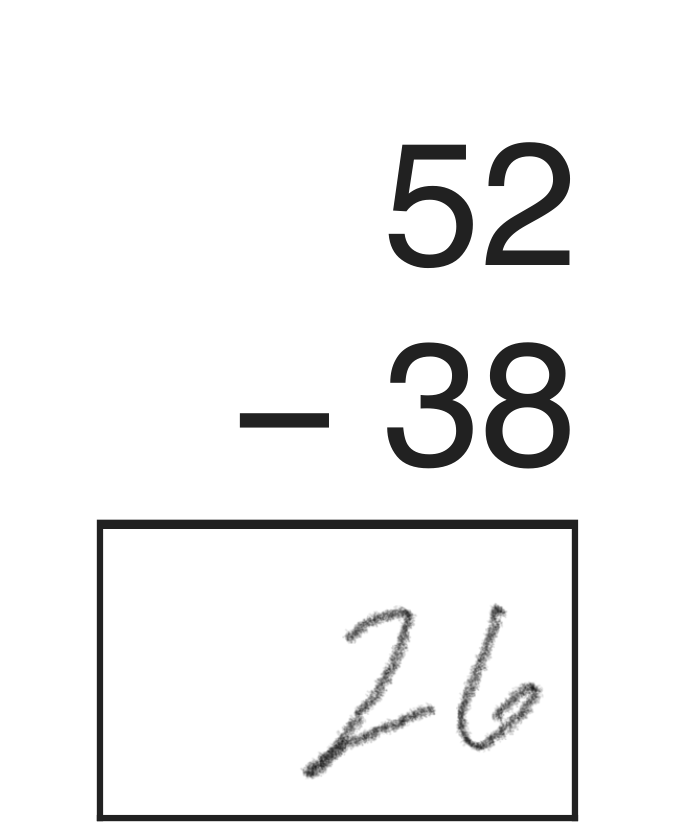
The right answer is 14. Your kid wrote 26 because, in the ones place, they did 8 − 2 instead of trading a ten to make 12 − 8. Lots of kids do this. It's fixable, and you can start tonight. In LOOP we call it "Took the smaller digit from the bigger one."
Your kid isn't being careless. They made up a rule that works until the top digit is the smaller one. Here the top 2 is smaller than the bottom 8, so it breaks.
What they wrote52− 3826
The right answer52− 3814
Here is what happened. They saw a 2 over an 8, flipped it, and wrote 8 − 2 = 6. The tens went fine (5 − 3 = 2), so the answer came out 26.
Here is the right way. 52 is 5 tens and 2 ones. Trade 1 ten for 10 ones, and you have 4 tens and 12 ones. Now 12 − 8 = 4 and 5 4 − 3 = 1, so the answer is 14. Teachers call the trade "borrowing."
Is it this, or something else?
Before you fix anything, look at what they actually wrote.
26Took the smaller digit from the bigger one. This is the page you're on.
24Borrowed for the ones but left the tens as they were. They borrowed for the ones (12 − 8 = 4) but forgot to cross out the 5, so the tens came out 5 − 3 instead of 4 − 3.
13 or 15Their method is fine; one fact slipped. Check which fact: 12 − 8 is the usual one.
One wrong answer might just be a slip. If the same thing shows up again and again, it isn't. The sheet below will show you whether this is a pattern.
Free printable: 12 problems
Two of these (58−23 and 97−45) need no borrowing, so they are your check. If those two come back right and the other ten are all too big, this is probably the mistake. Check the key below for the exact wrong answers.
A child making this mistake will write 26, 46, 45, 43, 33, 64, 42, 33, 31, 37 for problems 1, 2, 3, 5, 6, 7, 9, 10, 11, 12. Every one is bigger than the true answer. Problems 4 and 8 stay correct.
Subtracting with borrowing
Name ____________Date ________Subtract. Use a pencil.
1.52− 38
2.61− 27
3.74− 39
4.58− 23
5.83− 46
6.45− 18
7.90− 34
8.97− 45
9.63− 25
10.71− 44
11.86− 57
12.42− 19
looplearning.org
What to do this week
Day 1: Use dimes and pennies, or base-ten blocks if you have them. Lay out 52 as 5 dimes and 2 pennies. Ask your kid to take away 38, which is 3 dimes and 8 pennies. They only have 2 pennies, so they can't. Pause when they notice they only have 2 pennies, and don't tell them the trade. If they get stuck, ask what a dime is worth in pennies. Once they trade one dime for 10 pennies, they have 12 pennies and 4 dimes, and the taking away works.
Day 2: Same problems, now on paper. Before each ones column, have them say out loud: "Is the top number big enough?" In 52 − 38, is 2 big enough to take 8 from? No, so trade first.
Day 3: Do the printable again and count how many are still too big. If most of the ten are right now, you're good. If they're still getting the same wrong answer, do Day 1 again.
LOOP does this for every page. Your kid does a printed page in pencil. You take a photo. LOOP tells you which mistake showed up on each problem and prints the next page. Your kid works on paper the whole time.
Tyler Judson, LOOP co-founder. Before LOOP I tutored math, one kid at a time. LOOP is my try at giving every kid that kind of attention without a tutor in the room.
The mistake names are the ones LOOP uses for Grade 2 subtraction. The examples were checked by running LOOP's mistake-finder.